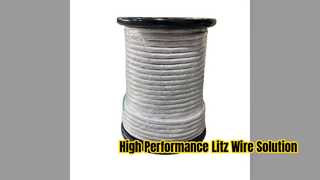
Brief: Temukan Kawat Litz Berlapis Sutra Dacron/Nylon Fiber berkinerja tinggi, dirancang untuk koil puncak dan aplikasi frekuensi tinggi. Kawat litz khusus ini menampilkan konduktor yang diisolasi secara individual untuk meminimalkan kerugian efek kulit, memastikan konduktivitas dan efisiensi yang optimal.
Related Product Features:
Features outer insulation made from Dacron fiber or Nylon fiber for enhanced durability.
Utilizes individually insulated strands with diameters ranging from 0.020 to 0.500 mm.
Designed with an overall diameter range of 0.1mm to 8mm for versatile applications.
Supports a maximum cross-sectional area of 38mm² for efficient current handling.
Weaving pattern ensures strands alternate positions to minimize electromagnetic losses.
Ideal for high-frequency applications including ignition coils and peaking coils.
Provides excellent solderability at 380±5°C for 30 seconds with smooth results.
Meets stringent specifications for breakdown voltage and enamel continuity.
Pertanyaan:
What is the primary benefit of using litz wire construction?
Litz wire construction uses individually insulated strands, each thinner than a skin-depth, to minimize skin effect losses. This ensures current is distributed evenly across all strands, improving overall conductivity and efficiency in high-frequency applications.
What materials are used for the outer insulation of this litz wire?
The outer insulation is made from either Dacron fiber or Nylon fiber, providing durability and reliable performance in various industrial and electronic environments.
What are the typical applications for this type of copper litz wire?
This litz wire is commonly used in peaking coils, antenna coils, channel coils, IF coils, ignition coils, and other high-frequency coils where minimizing electromagnetic losses is critical.
What is the specified breakdown voltage for this product?
The product meets a breakdown voltage specification of ≥1.1 KV, with test results typically showing values around 1.5 KV, ensuring reliable insulation performance.